
Why is AT assessment so important?
Assessing an individual's assistive technology needs makes it far more likely to identify AT devices and services which will improve their functional capabilities. A poor match between technology and user more often than not leads to abandonment of the technology, and thus loss of the desired outcome. Various studies and surveys indicate that half and possibly as much as 80% of assistive technology is abandoned by the prospective user. Often, this is because the technology was not a good match for the user's abilities, needs, preferences, the task to be accomplished, or the context of the technology's use. So the first and arguably most important step is to identify the right tool for the job.
AT assessment starts with asking the right questions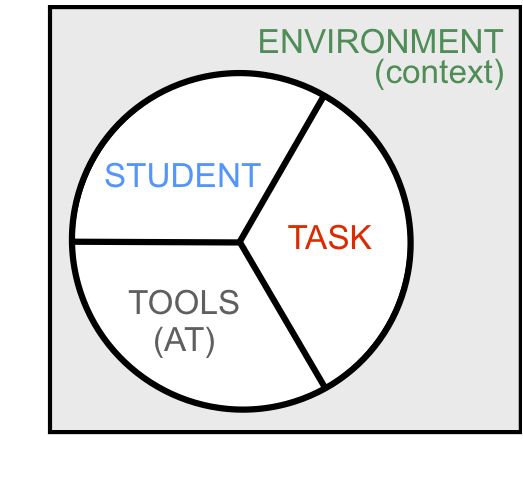
More than anything, matching an individual with the appropriate assistive technology involves asking, and seeking answers to, the right questions -- about the tasks where the student has difficulties, the student’s abilities and challenges, and the context in which the student performs those tasks.
The most effective technology tools are those selected with these factors in mind. The more we understand about the interaction between the PERSON, the TASK or activity they have difficulty with, and the ENVIRONMENT or context in which they perform that task -- WHO needs to do WHAT, WHERE? -- the better equipped we are to identify TOOLS (the assistive technology) to help produce the desired outcomes.
In the context of education, this is often referred to as the SETT framework -- Student, Environment, Task, and Tools. SETT was developed by educator Joy Zabala, Ed.D. as "a four part model intended to promote collaborative decision-making in all phases of assistive technology service design and delivery from consideration through implementation and evaluation of effectiveness." It is used in schools throughout the country.
"What is the best tool for ___?" That depends...
A common question is "What's the best technology for [reading, writing, taking notes, etc.]?". By way of analogy, let's look at the "best" cooking tools (utensils, appliances) to prepare a meal. The first question that comes to mind is "What kind of meal will you prepare?". Choice of tools will vary greatly depending on whether you wish to make a sandwich, cook a frozen microwave meal, or prepare a multi-course Thanksgiving dinner. The second question to ask is "Who will do the cooking?". Is it a college student with moderate cooking experience, a young child, or chef Julia Child? Lastly, we need to ask about the context in which the meal is prepared. Is it to be cooked in a well-equipped kitchen, a college dorm room, or at a campsite? Do you have several hours or only 10 minutes? Will the meal be prepared independently, or is help available?
By asking the right questions in advance, we can identify the "best" tools for making that meal. Likewise, to identify the most appropriate technology learning tools for an individual, we need to first know about the person, the nature of the task, and the environment in which they will perform that task.
The Right Tools for the Job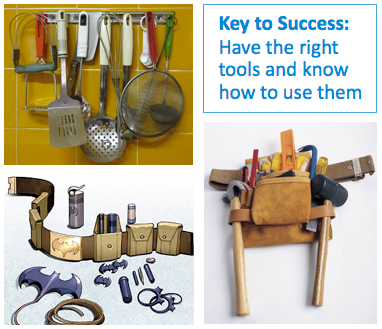
A skilled craftsman, an expert cook, and even a masked crimefighter can all attribute at least some of their success to one thing: having the right tools for their jobs. Likewise, the successful learner will have a variety of technologies in their “toolbelt”, know how to use them, and know which tool is best for a given task. Though the assortment of tools may evolve over time to accommodate changing needs and abilities, such a toolbelt will serve an individual with learning differences through middle school and high school, into college, and beyond.
For example, a student who struggles with reading fluency, comprehension, and critical thinking will likely benefit from an assortment of tools for different tasks and contexts – for example:
- a simple text-to-speech utility like Microsoft Immersive Reader or the Speak Selection function on a Mac or iPad to hear webpages and documents spoken aloud
- robust literacy & learning software like Texthelp Read&Write or Kurzweil 3000 to support reading comprehension and annotation
- an iPhone app or Android app for listening to human-narrated audio textbooks on-the-go
- an OCR (optical character recognition) utility to scan and convert inaccessible print text into accessible e-text that can be read aloud by text-to-speech
- memberships in Bookshare and Learning Ally (eligibility required), Audible, Overdrive, and other sources for print books in alternative forms.
The student's choice of tools would depend on the material to be read and the purpose for reading it (e.g., a novel for pleasure vs. a science textbook for taking notes and studying later). The goal is to equip the student with a well-thought-out collection of tools and provide the skills and confidence to use them effectively.
AT assessment is a collaborative process, not a one-time event by a specialist
This is especially true when identifying technology tools for students. The Individuals with Disabilities Education Act (IDEA) instructs school district IEP teams to consider if a student requires "assistive technology devices and services" to achieve their goals as well as a Free and Appropriate Public Education (FAPE) in the Least Restrictive Environment (LRE), then to integrate AT that proves to be effective into the student's IEP. Determining which AT will be effective often requires an "assessment of assistive technology needs".
Rather than a one-time “event” conducted by a specialist, assistive technology assessment is best thought of as a collaborative process by which a team (e.g., IEP team) determines what technologies would improve a student's performance, participation, and independence. As illustrated above, this process should take into account not only the student's learning strengths and weaknesses, but also the nature of specific tasks to be performed, and the environments in which the student performs these tasks -- the physical environment, social environment, and the context (such as working independently or with others). Accomplishing this relies on the collective knowledge and skills of the individual team members, each of whom has a unique perspective of the student and his/her abilities, level of performance, curricula, etc. both in school and at home.
Depending on the expertise within the team, they may seek the services of an outside AT specialist to conduct specialized evaluation and training, recommend specific assistive technologies, and coordinate the needs assessment process, but the inputs and involvement of the entire team are what produce successful results.
Lastly, a proper AT assessment also considers necessary supporting services such as training for student and/or staff, integration of the AT into school and home life, and technical support issues. It also provides a plan for implementation and for evaluating student progress with the AT. And AT assessment always considers the perspective and inputs of the student.
NOTE: Because understanding the individual's learning weaknesses and strengths is such an important part of the AT assessment process, it is often helpful to obtain a diagnostic or psycho-educational evaluation from a qualified professional prior to conducting an assistive technology needs assessment.
Start by choosing features, not products
Let's say the student is a slow reader and the team believes he or she might benefit from literacy software with text-to-speech which reads books aloud. What software, if any, would be most beneficial? Before answering that, we need to ask other questions.
Knowing the cause of the slow reading (decoding problems, weak vocabulary, visual processing, attention?) and the need for associated tools (e.g., assistance with writing), would help the team to decide which generic technology features might be effective (e.g., text-to-speech; text highlighting; adjusting colors, fonts, and word spacing; built-in reference tools; word prediction). The student's social circumstances and personal preferences (e.g., not wanting to appear different) might call for a less conspicuous solution in certain settings, such as software with a more subtle user interface, or listening to a narrated digital audiobook while following along in the print version. After matching the student's specific needs with functional features, the team can make educated choices as to which technology products are most likely to produce the desired outcomes.
How I assess an individual's AT needs
Working collaboratively with individuals, families, school teams, and other providers as appropriate, I use a “best practices” approach to gather information, conduct trials with various assistive technologies, and brainstorm potential solutions aimed at minimizing the impact of learning deficits and capitalizing on the individual's learning strengths.
Generally, the initial AT assessment process comprises five "phases":
- Define the problem and "consider" assistive technology - What does the student need to do, but can't (or has difficulty doing) because of a disability or learning difference? If the student cannot adequately perform these tasks using existing strategies and accommodations, consider whether use of assistive technology tools might help. (IDEA requires IEP teams to consider assistive technology.)
- Gather relevant data about the student strengths and needs, tasks, barriers to performance, learning environments, and the student's current level of performance in his/her customary environments. Much of this comes from existing documents (IEP, 504 plan, educational evaluations), but also from interviews with teachers or family, classroom observations (if necessary), and working one-on-one with the student.
- Generate potential solutions - Based on the information collected, identify tools, strategies, and supporting services which hold promise to improve performance, increase participation, and support independence.
- Conduct AT trials - Develop and implement an AT trial plan, including timelines and criteria for determining success, and collect measurable data on the impact to student performance in the student's customary environments. This is often conducted over an extended period in collaboration with the school district staff and others. The goal is to validate the effectiveness of the chosen technologies so as to provide greater confidence about the decisions.
- Integrate successful/appropriate AT tools and strategies - Analyze results, determine most appropriate tools and strategies based on the trials (or whether additional trials are needed), and develop a plan to implement the recommended technology. Document required tools and strategies in student's IEP (if they have one).
Reconsideration and additional assessment should be conducted as needs change, tasks change, performance improves, or the student's needs are no longer being met by the current technology.